What Is Whole-Home Surge Protection and Is It Worth It?
Whole-home surge protection is worth it in Upland, CA for most homes with electronics, solar, or EVs. Here's what it costs in 2026 and how it works.
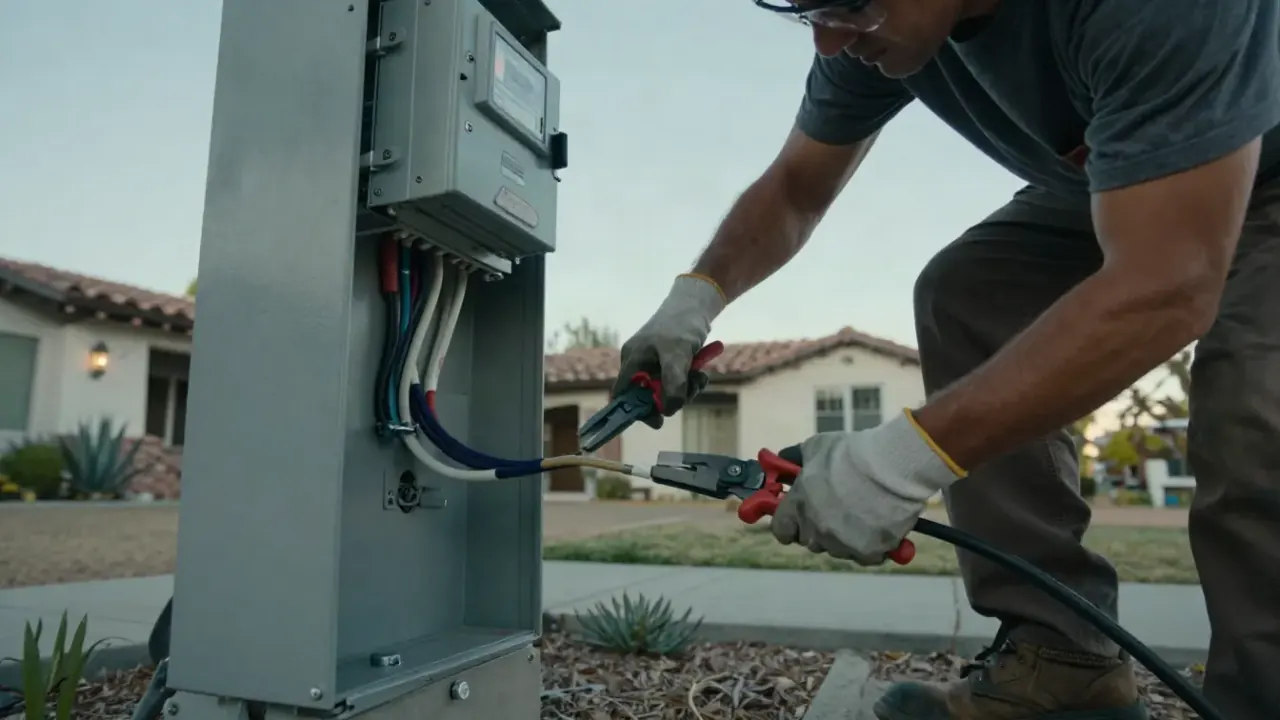
Whole-home surge protection is worth it for most Upland homes that have a modern panel, a few thousand dollars of electronics, and any solar or EV equipment on the property. A single hardwired suppressor at the panel costs far less than replacing a furnace control board, a refrigerator inverter, or a garage door logic board after a grid spike.
We install these units across Upland every month, and the pattern is always the same: the homeowners who call us after a surge are the ones who didn't have one. Here's how the device works, what it costs in 2026, and how to tell whether your house actually needs one.
What Whole-Home Surge Protection Actually Is
Whole-home surge protection is a hardwired device installed at your electrical panel that clamps voltage spikes before they travel down your branch circuits to your appliances. It is not a power strip and it is not a battery backup. It is a sacrificial component - a metal oxide varistor (MOV) array - that absorbs excess voltage and shunts it to ground in nanoseconds.
Every home already has some surge protection built into the grid. Your utility transformer, your meter, and the electronics inside each appliance handle small fluctuations. What they don't handle is the big stuff: a lightning strike two streets over, a utility switching event, or the surge your own HVAC compressor creates when it kicks on. Those events push 1,000 to 6,000 volts onto a 120-volt circuit. That's what a whole-home unit is designed to catch.
We install these at the top of the panel, wired to a dedicated 2-pole breaker. The unit sits flush against the wall next to the panel, usually about the size of a hardcover book. Installation takes our electricians 45 to 90 minutes on a standard 200-amp panel.
Is Whole-Home Surge Protection Worth It in Upland, California?
Yes - for most Upland households, whole-home surge protection pays for itself the first time it saves a major appliance. The math is simple. A quality unit installed runs $450 to $950 in 2026 depending on panel type and whether we're adding it during a larger upgrade. A single failed refrigerator inverter board costs $400 to $700 to replace. A furnace control board runs $500 to $1,200. A pool pump motor is $600 to $1,500.
Upland has a few local factors that push the value higher than the national average:
- Summer monsoon season. From July through September, the San Gabriel Valley gets dry lightning and fast-moving thunderstorms. We see a spike in surge-related service calls in August and September every year.
- Older housing stock. A large share of Upland homes were built between 1955 and 1985. Many still have original 100-amp panels with no spare breaker space, which means a surge protector installation near me Upland CA often gets bundled with a panel upgrade.
- Solar adoption. Upland has one of the higher residential solar densities in San Bernardino County. Inverters and solar monitoring gear are sensitive to surges from both the grid and the array itself.
- EV charging. Level 2 chargers pull 40 to 48 amps continuously. When they cycle on, they create their own inductive kickback on the panel.
If your home has any two of those four factors, the answer is almost always yes. If you're in a newer build with a 200-amp panel, no solar, and no EV, the case is weaker - but still reasonable at the low end of the price range.
How Much Does Whole House Surge Suppressor Cost in Upland CA?
Typical 2026 pricing for a whole house surge suppressor in Upland, California runs $450 to $950 installed, with most single-family homes landing between $550 and $750. That number includes the device, the dedicated breaker, the wiring, and the labor.
Here's how the range breaks down:
- $450-$600: Standard 120/240-volt unit on a modern 200-amp panel with open breaker space. This is the most common scenario in The Colonies and newer North Upland tracts.
- $600-$800: Higher-joule commercial-grade unit, or a panel with limited space that requires a tandem breaker swap. Common in 1960s-1970s homes near Historic Downtown Upland.
- $800-$950+: Installation during a larger service change, or on a 400-amp panel with multiple subpanels. We often handle this alongside a 200 to 400 amp service upgrade Upland CA when the homeowner is already opening up the wall.
What drives the price up: panel age, no open breaker slots, an exterior-mounted panel exposed to sun, or a need for a second unit on a detached garage subpanel. What drives it down: bundling with other work you were already planning.
One thing we tell every customer - a $30 big-box surge strip is not a substitute. Those protect one outlet. A whole-home unit protects every circuit in the house, including the hardwired ones you can't reach with a strip: your furnace, your well pump, your garage door opener, your dishwasher.
What a Whole-Home Surge Protector Protects (and What It Doesn't)
A whole-home surge protector shields every circuit fed from your main panel - which is nearly everything in the house. That includes your HVAC system, refrigerator, washer and dryer, dishwasher, garage door opener, pool equipment, and any hardwired lighting or security system.
What it does not do:
- It won't stop a direct lightning strike. Nothing residential does. It will, however, handle the indirect surges that come from strikes within a few hundred feet.
- It won't protect low-voltage data lines. Coax, ethernet, and phone lines need their own small suppressors at the point of entry. We install those as add-ons for $75 to $150 each.
- It won't last forever. A quality unit has a lifespan of 5 to 10 years, or fewer if it absorbs a major event. Most have an indicator light that goes dark when the MOVs are spent. When that light dies, the unit is a paperweight.
We check the indicator light on every service call we run. It takes ten seconds and it's the difference between being protected and thinking you're protected.
Whole-Home Surge Protection for Solar and EV Homes in Upland CA
Solar and EV households in Upland get more value from surge protection than anyone else, because they have more sensitive electronics and more sources of surge. A rooftop array is a giant antenna. Every nearby lightning strike induces current on the DC lines running from the roof to the inverter. That current has to go somewhere, and if it goes through your inverter, you're looking at a $1,500 to $3,500 replacement.
We install surge protection on the AC side at the main panel and, when the homeowner wants full coverage, on the DC side at the inverter disconnect. For EV owners, the charger itself is a surge source - the contactor inside a Level 2 charger creates an inductive kick every time it opens. A whole-home unit absorbs that before it reaches the rest of the house.
If you're planning an EV charger or adding solar, the smart move is to handle it during the panel work. We do this all the time on EV-ready and solar-ready panel upgrades Upland CA - the panel is already open, the wall is already accessible, and the incremental cost of adding surge protection is a fraction of a standalone install.
Common Mistakes We See With Surge Protection in Upland
The most common mistake we see is homeowners buying a $40 plug-in unit and calling it done. That device protects the two or three things plugged into it. It does nothing for your furnace, your AC condenser, or your garage door opener.
Other mistakes:
- Installing on an undersized panel. If your 100-amp panel is already at capacity, adding a surge protector without a load calculation can push you over. We run a electrical load calculation and inspection Upland CA before we add anything to a full panel.
- Ignoring the ground. A surge protector is only as good as the ground path it dumps to. If your grounding electrode conductor is corroded or undersized, the unit can't do its job. We check this on every install.
- Forgetting the subpanel. Detached garages, pool equipment pads, and ADUs on their own subpanel need their own protection. A single unit at the main panel doesn't cover a detached structure 80 feet away.
- Never checking the indicator light. We've pulled units that died three years ago and the homeowner had no idea.
- Skipping it because "we have good power here." Upland's grid is reliable, but reliability and surge immunity are different things. Most surges come from inside the house, not the utility.
When to Call a Professional
Call a licensed electrician if your panel is older than 25 years, if you don't have two open breaker slots, or if you've already lost an appliance to a surge and want to know why. Those three situations need eyes on the panel, not a guess.
We handle surge protection as a standalone job and as part of larger panel work. If your panel is a 100-amp unit from the 1970s, the surge protector is a good idea but the panel itself is the bigger problem - and we'll tell you that straight instead of selling you a device that's bolted to a panel that needs replacing. If you're in one of the older neighborhoods near Historic Downtown Upland Electrical Panel Upgrade territory, we see this combination constantly.
For homeowners who want the full picture before deciding, we offer a Electrical Panel Upgrade Upland CA assessment that covers panel capacity, grounding, breaker condition, and surge protection in one visit. No pressure, no upsell - just a clear answer on what your house actually needs.
Frequently Asked Questions
What is whole-home surge protection in Upland CA?
It's a hardwired device at your electrical panel that clamps voltage spikes before they reach your appliances. In Upland, it's typically installed on a dedicated 2-pole breaker and protects every circuit in the house, not just one outlet.
Is whole-home surge protection worth it in Upland, California?
Yes, for most homes. At $450-$950 installed in 2026, it costs less than replacing one major appliance. Homes with solar, EV chargers, or electronics-heavy setups see the strongest return.
How much does whole house surge suppressor cost in Upland CA?
Typical 2026 pricing is $450 to $950 installed, with most single-family homes landing between $550 and $750. Bundling with a panel upgrade or service change usually lowers the incremental cost.
Can whole-home surge protection protect my electronics in Upland CA?
It protects everything on your panel's circuits - TVs, computers, appliances, HVAC, and hardwired systems. For full coverage, add small suppressors on coax and ethernet lines at the point of entry.
How long does a whole-home surge protector last?
Five to ten years under normal conditions, less if it absorbs a major event. Check the indicator light every few months - when it goes dark, the unit needs replacing.
Get Help With Electrical Panel Upgrade in Upland
If you want a straight answer on whether your Upland home needs whole-home surge protection - and what it would cost on your specific panel - we'll come out, look at the setup, and give you a number. No guesswork, no pressure.
Call Upland Electrical Panel Upgrade at (909) 850-3163 to schedule your assessment.