Fuse Box vs Breaker Panel: What Homeowners Should Know
Fuse boxes and breaker panels both protect your wiring, but they fail differently. Here's what Upland homeowners need to know before deciding to upgrade.
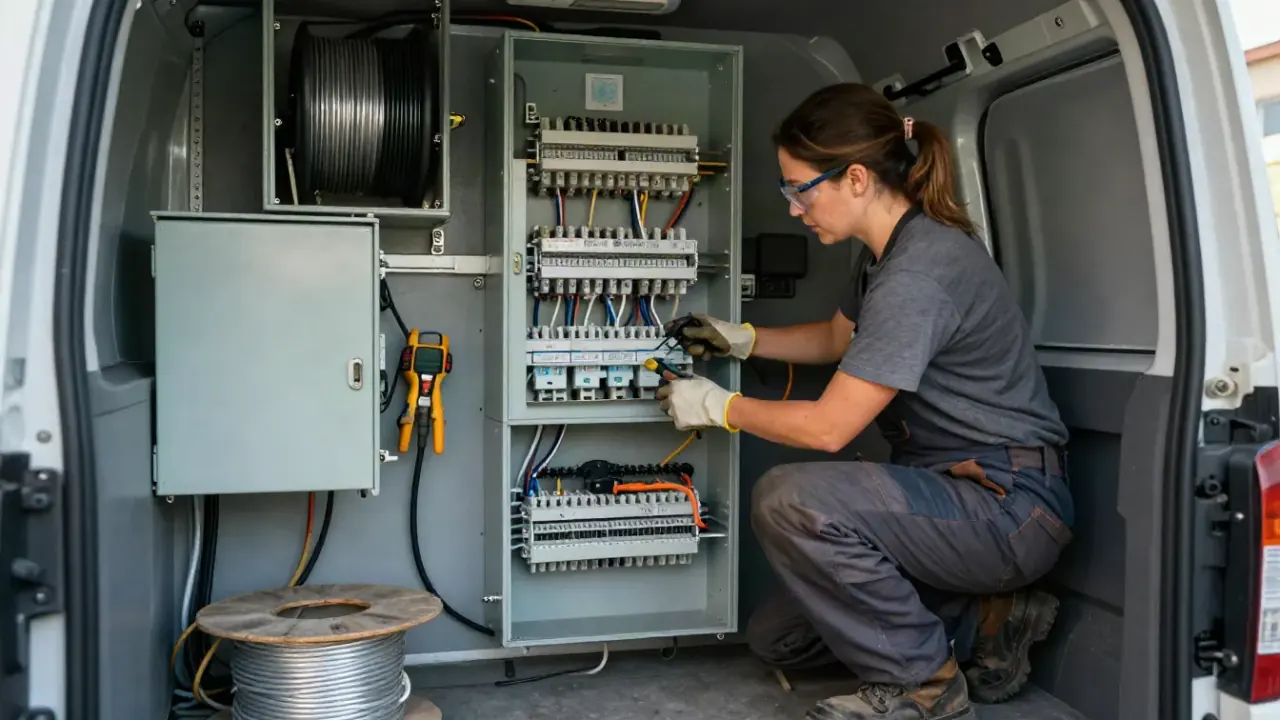
A fuse box uses replaceable screw-in fuses that melt when overloaded, while a breaker panel uses resettable switches you flip back on. That single difference drives everything else: how fast you restore power, how safely the system handles modern loads, and how insurable your home is. If you own an older house in Upland, you are probably weighing whether to keep the fuse box or convert it. This post covers the differences, the real dangers, 2026 conversion costs in Upland, and how to know when it is time to upgrade.
The Short Answer: Fuse Box vs Breaker Panel
A fuse box protects your wiring by burning out a one-time fuse when current exceeds its rating. A breaker panel protects the same wiring by tripping a reusable switch. Both interrupt the circuit. The breaker panel just does it faster, more precisely, and without a trip to the hardware store.
In Upland, we still find fuse boxes in homes built before the mid-1960s, especially around the older blocks near Historic Downtown Upland. Those systems were designed for a fraction of the electrical load a modern household draws. Adding a heat pump, EV charger, or even a second refrigerator pushes them past their comfort zone.
Here is the practical difference in one line: a fuse box is a 1950s solution to a 2026 problem.
What Is the Difference Between a Fuse Box and a Breaker Panel?
The fuse box vs breaker panel comparison comes down to four things: how they trip, how you reset them, how many circuits they can safely carry, and how well they handle modern appliances.
How They Trip
A fuse contains a metal strip that melts when current exceeds the fuse rating. That melting is the protection. It is reliable but imprecise. A breaker uses a bimetallic strip or electromagnet that trips at a set threshold, then resets with a lever.
How You Reset Them
When a fuse blows, you need the correct replacement fuse on hand. If you install a 30-amp fuse in a 15-amp circuit, you have just removed the protection. When a breaker trips, you walk to the panel and flip it back. No parts, no guesswork.
Circuit Capacity
Most residential fuse boxes in Upland carry 60 amps. Some carry 100. A modern home with central air, an electric range, a dryer, and an EV charger needs 200 amps. That gap is why so many fuse-box homes feel like they are always on the edge.
Modern Loads
Fuse boxes were not built for AFCI or GFCI protection, which the California Electrical Code now requires in most living areas, kitchens, baths, and garages. Breaker panels accept those breakers directly. If you want to add AFCI and GFCI breaker installation Upland CA, you need a breaker panel to land them in.
Are Fuse Boxes Safe in Upland CA?
A fuse box that is correctly wired, properly fused, and not overloaded can be safe. The problem is that most fuse boxes we open in Upland are none of those things. They are 60 to 70 years old, and the safety depends on every previous owner having done the right thing.
What we actually find:
- Oversized fuses. A 30-amp fuse in a 15-amp circuit. This is the single most common issue, and it defeats the entire protection system.
- Pennies or foil behind fuses. Yes, still. People did this decades ago to stop blowing fuses. It turns the fuse into a solid wire.
- Frayed cloth wiring. Common in pre-1950 Upland homes. The insulation crumbles when you touch it.
- Corroded fuse clips. Loose contact creates heat, and heat creates fires.
- No grounding. Two-prong outlets throughout the house, which means no path for fault current.
If your fuse box has any of these, it is not a question of whether to upgrade. It is a question of how soon. We have walked into fuse-box homes in Electrical Panel Upgrade in Historic Downtown Upland where the panel cover was warm to the touch. That is a today problem, not a next-year problem.
Should I Replace My Fuse Box in Upland, California?
Yes, if any of these apply: you are adding a major appliance, your insurance company has asked about the panel, you are selling the home, or you have blown a fuse more than twice in the last year. Those are the triggers.
Here is how we think about it. A fuse box is not automatically unsafe. But it is a limiting factor. It caps your home at 60 or 100 amps. It cannot accept modern safety breakers. It cannot support an EV charger, a heat pump, or a tankless water heater. And it gives a home inspector a reason to write a paragraph.
If you are planning to stay in the house, converting now means you stop thinking about it. If you are selling, a breaker panel removes an objection before it comes up. Either way, the work is the same: fuse box to breaker panel conversion Upland CA done by a licensed electrician, permitted, and inspected.
What the Conversion Actually Involves
We pull the meter, remove the old fuse box, mount a new breaker panel, run new feeders, land the existing circuits on new breakers, add AFCI and GFCI protection where code requires it, and ground the system properly. Most conversions take one to two days. If the service mast or meter main is also outdated, we handle that in the same visit.
We also run a load calculation before we size the panel. That tells us whether you need 100 amps, 200 amps, or 400. Guessing here is how homeowners end up paying twice.
Fuse Box to Breaker Panel Conversion Cost in Upland CA
Typical 2026 pricing in this area runs $2,800 to $6,500 for a standard fuse box to breaker panel conversion, depending on panel size, circuit count, and whether the service mast needs replacement.
Here is the rough breakdown we give homeowners:
- 100-amp conversion, simple layout: $2,800 to $3,800
- 200-amp conversion, typical Upland home: $4,200 to $6,500
- 200-amp with new meter main and mast: add $1,500 to $2,800
- 400-amp service for large homes or ADUs: $7,500 and up
Permits in Upland and San Bernardino County add a few hundred dollars. We pull them. The inspection is part of the job, not an extra.
What moves the number most is circuit count and wire condition. A fuse box with 8 circuits and clean wiring is a straightforward swap. A fuse box with 16 circuits, cloth wiring, and a rusted mast is a bigger day. We quote both scenarios upfront so there are no surprises.
If you want more capacity for an EV or solar, we install EV-ready and solar-ready panel upgrades Upland CA at the same time. Running the conduit once is cheaper than running it twice.
Common Mistakes We See With Old Fuse Boxes
The mistakes are almost always the same, and they all come from someone trying to stop a fuse from blowing instead of figuring out why it is blowing.
- Upsizing the fuse. If a 15-amp fuse keeps blowing, the circuit is overloaded or faulted. Putting in a 20 or 30 defeats the protection.
- Using foil or pennies. We still find this. It is the most dangerous thing you can do to a fuse box.
- Ignoring warm covers or a burning smell. Heat at the panel means loose connections or overloaded conductors. That is an emergency, not a maintenance item.
- Adding circuits without a load calculation. A new subpanel or a hot tub circuit on a 60-amp service is a recipe for nuisance trips and worse.
- DIY panel swaps. This is not a homeowner job. The meter has to be pulled, the work has to be permitted, and the inspection has to pass. We fix DIY panels regularly.
If you are seeing any of these in your own panel, stop using the circuit and call us. We would rather look at it today than hear about it later.
When to Call a Professional
Call a licensed electrician when your fuse box is warm, when a fuse blows more than once a month, when you are adding any major appliance, or when your insurance company asks about the panel. Those are the four triggers.
We handle outdated panel replacement Upland CA every week, and most of those calls start the same way: a homeowner who noticed something small and decided not to wait. That is the right instinct. Electrical problems do not improve on their own.
If you are in one of the older neighborhoods, we also work regularly in Electrical Panel Upgrade in North Upland, where mid-century homes still carry original 60-amp service. Same job, same process, same inspection.
We give you a flat price before we start. No hourly surprises.
Frequently Asked Questions
What is the difference between a fuse box and breaker panel in Upland CA?
A fuse box uses one-time fuses that melt on overload; a breaker panel uses resettable switches. Breaker panels handle higher amperage, accept AFCI and GFCI breakers, and reset in seconds without replacement parts. That is the core difference.
Should I replace my fuse box with a breaker panel in Upland, California?
Yes, if you are adding appliances, planning to sell, or your insurer has flagged the panel. Most Upland fuse boxes cap at 60 to 100 amps, which is not enough for a modern home. A 200-amp breaker panel fixes that in one to two days.
Are fuse boxes safe in Upland CA?
A correctly wired, properly fused fuse box can be safe, but most we inspect are 60-plus years old with oversized fuses or damaged wiring. If yours has warm covers, cloth wiring, or repeated blown fuses, it is not safe as-is.
How much does fuse box to breaker panel conversion cost in Upland CA?
Expect $2,800 to $6,500 in 2026 for a standard conversion, depending on amperage and circuit count. Adding a new meter main or mast pushes it higher. Permits and inspection are included in our quotes.
How long does a fuse box to breaker panel conversion take?
Most conversions take one to two days. If the service mast or meter main also needs replacement, plan on two to three days. We pull the permit and schedule the inspection as part of the job.
Get Help With Electrical Panel Upgrade in Upland
If your fuse box is original to the house, we can tell you in one visit whether it needs replacement or just a closer look. We handle the permit, the conversion, and the inspection from start to finish.
Call Upland Electrical Panel Upgrade at (909) 850-3163 to schedule your panel evaluation.